Friday, October 31, 2014

Cakes and Coyotes

As a volunteer specialized in working with youth, I spend a lot of times with kids. Effectively having done the same type of work in the US, I know that I have a love-hate relationship with working with kids. They can be heinous, rude, incredibly inconsiderate and oblivious to the fact that you aren't trying to make they're lives more difficult but rather trying to help them. But also they can be tremendously sweet, simplistic in their show of affection by running up to you and showering you in hugs. One of the best things about working with youth is their innocence. They are just reflections of the people around them, only beginning to forge who they are, before they reach adulthood and cement their personalities and lose their sense of wonder of the world around them. Like my father told me once, children are great because "their cake isn't baked yet". It's still in that primordial goo, sweet and unsure what shape it will take. I guess that makes me the baker by profession.

There is a sense of honor in being a volunteer working on youth development in a country like El Salvador simply because the situation is so dire. Along with police officers, students are one of the principal targets of gang violence whether it be for the people in their social circle or their unwillingness to join gangs. Kids are abandoned by their parents,  who journey to the United States, only to send remittances back. Or you have parents that suffered great tragedies during the civil war, entire families being murdered, who are still on survival mode, uneducated and unaware that by not making education a priority with their children, they are effectively condemning them to the poverty that they all know too well. On top of all of this you have one of the largest humanitarian crises of the 21st century.

It's difficult to unpack all the things wrapped up in the recent US immigration crisis of unaccompanied minors. There are so many statistic, story-lines, differing reasons and motivations on a person to person basis that it's almost impossible for me to talk about these things in general terms. Let me be clear that my feelings on this are based on my small community in the Northeast of El Salvador, a community I still struggle to understand.

From my school there where about 9 out of 250 children who emigrated within the last year. This statistic is much higher in some of my colleagues' sites where it seemed like everyone under 18 was disappearing overnight. I say overnight because the number of unaccompanied minors from El Salvador skyrocketed from 5,990 in 2013 to 16,404 this year alone. This spike seems bewildering until you start looking at the mechanics. By nature the black market is clandestine. People here talk about going "mojado" to the US by they don't say more than they have to. Hopeful emigrants don't know any more about the journey than what they're told by family and friends in the US. The United States until this year had kept quiet on their deportation policy for unaccompanied minors. They never openly said that they didn't deport minors, that they let them stay. But from one-word-of-mouth to another, this fact got out. Pretty soon, it seemed all undocumented immigrants with children in El Salvador knew. And then, boom, you have yourself an immigration crisis.

I remember in April I was participating in a training at our regional office when my colleagues and I were visited by the US Deputy Chief of Mission of El Salvador (the second most important person from the embassy after the ambassador). He brought us doughnuts and wanted to talk. He was there because like everyone else, he had no idea what to do about the immigration crisis and was looking to us for insight, to dissect this monolithic problem by looking at the collective parts of our individual experiences, the stories we knew from our communities. We all shared our anecdotes, the reasons why youth were leaving, basic information on the prices and structure of human trafficking. It was an extremely rich dialogue but I think all of us left with more questions than answers.

And that's the thing, when you have so many lives wrapped into one massive humanitarian crisis, you can only talk about what you've seen.

You read a lot in the news how children are fleeing El Salvador because of the gang-violence, that it's life or death. While it's true, there are cases like that, I wonder if that's the norm or the exception.

In my community, there isn't gang violence to speak of, but there are a lot of kids with parents in the US. You instantly know who they are because of their iPhones, Levi jeans, nice shoes, and other possessions. You don't even have to ask. Their parents have left long ago, making their children trade the experience of growing up with their parent for financial security and nice things.

"Going to the US is the only way for me to provide for my family"

You here that a lot. On face-value it seems like a no-brainer. Parents risking their lives to make the dangerous journey to the US for their loved ones. And it is courageous, selfless, but only to a certain extent. Only until you consider what actually happens to their kids. I've heard a lot of stories about kids being left with relatives only to be neglected, their wellbeing treated like a secondary job by family members who wait for the next remittance check to come. The kids they grow up knowing their parents as an old photo, a voice on the phone, and presents in the mail. There are obvious psychological effects of not knowing your parents but I'd argue that the social effects are greater.

Partly out of guilt, partly out of wanting to give their children everything they never had growing up, Salvadoran parents living in the US shower their kids in gifts. Unlike other kids, they never have to worry about money, it just materializes in front of them. Now, if you're used to money literally showing up at your doorstep, are you going to force yourself to support yourself? No. You become dependent. Your well-being is already taken care of, why work or even go to school for that matter?

This is the remittance-kid's mindset. They become dependent, lazy, unambitious. If you're a parent you might pat yourself on the back, thinking that you've done your job. You've fed your child, clothed them, given them everything they ever wanted. But what you've actually done is ruined them. Like a animal born in a zoo only to be released into the wild, once the sustenance stops, they are left vulnerable and clueless in self-preservation and autonomy.

So when undocumented parents heard that they could bring their kids to the US with no legal repercussions, many didn't think twice, they want to give there children everything after all. It costs anywhere from five to seven-thousand dollars to pay a Coyote (human trafficker) to take you to the United States from El Salvador. Many times parents pay the same Coyote that they used to get them to the US to try and cross their children.

There are many horror stories of crossing the border. Women and children raped, literally sold into slavery. I remember one of my colleagues telling me that a little girl that they lived with was going to be smuggled to the US by a Coyote. They told me they tried talking to the girl's grandmother about the dangers, all the terrible things that could happen to her granddaughter. But in the end, the risk was worth it for all of them, even the girl. Of course a little girl is going to take the opportunity to see her mother for the first time in a decade and not think of the risks. That's what's wrong. These adults are making decisions, possibly life-altering decisions, for their kids, as if them, the parent, coming home is completely out of the question. The kids must go find them. I just can't agree with that.

Poverty is a reality here, much more for some than others. A lot of Salvadoran parents see going to the US as the only way for them and their families to survive. But there are also parents that struggle, selling baked goods, fruit or whatever they can find in order to support their kids. Sure their kids are going to grow up poor, but they'll at least know their parents. They'll never have to risk their lives to get to meet their parents. I guess that's what it comes down to for me. No amount of money can ever replace the presence of parent.

On a personal level, there is no doubt in my mind that this is where I belong. The timing of me living here couldn't be any more perfect. I'm a volunteer when volunteers are needed most. When kids need someone the most. I'm unsure what my time here will accumulate to but I am grateful for the opportunity to try and help.

Thursday, September 18, 2014

Por la plata baila el mono

In an age where capitalism is as far spread as its right arm Coca Cola, El Salvador is no exception. Everything here has a price, even a human life.

Developing countries typically have absurdly low cost of labor. For example, if a Salvadoran works eight to ten hours in the field, they earn around six dollars. Construction pays a little better at eight dollars a day. If you're an experienced construction worker, you hit the jackpot, raking in 10 dollars for a full day's work. Other jobs exist in this country, but if you are uneducated, unqualified, and just unlucky it's either the field or the construction site for you.

These jobs are by no means stable. You may be lucky enough to find work for two weeks straight and then be unemployed for months until the next job shows up. Employment is a cat and mouse game that people of all ages play.


It's no longer surprising to me to see kids ditch school for work. Sometimes they don't have a choice in the matter. It's the harvest season and mom tells him to pick up the machete instead of his backpack. End of discussion. In other instances, kids have just lost interest. Even if kids manage to make it all the way through high school, which is not common, the chances of them getting a good job are slim. It's easy to see why they shrug there shoulders like "What's the point?" when I ask them why they aren't at school.

What does surprise me is the elderly at work.


Especially coming from a country where the image of the prototypical senior citizen is a impossibly fragile relic, farting around in velcro shoes and a adult diaper, seeing an 80 year old doing manual labor is down right unbelievable. My host grandfather's name is Pedro. He's 83 and has somewhere around 20 children. While his babymaking days are behind him ("The factory is closed" he admits) he still works long hours at the milpa, or the corn field. I've gone down to his milpa before. While only about a 40 minute walk, one must traverse a cliff, making the journey part walk, part climb. Coming back up the cliff, I need to take multiple breaks and always summit drenched in sweat and mud. He on the other hand does this all the time, sometimes with a 50 pound load of corn on his back. Effortless. Now try to imagine your grandfather doing that. You can't.

But I digress.

The astoundingly low cost of labor is one of the main driving factors for Salvadoran emigration to the United States.  In many US cities, a Salvadoran can make in an hour what he would make in a full day in El Salvador. It's hard to deny how appealing that must be for anyone living here.

It just comes down to the fact that there aren't many ways to make a lot of money in this country. And then people wonder why so many kids are going to the US, why so many Salvadorans become gang members and terrorize this country, why alcoholism is truly an epidemic.

Even Salvadorans that are already making money don't see the point of playing the game by the rules.

Just last year, 14 members of the Salvadoran national soccer team were banned for life after rigging international games for monetary bribes. For a country that worships soccer and those that play it, it was like having their national idols crucified on a world stage.


This year, former president Francisco Flores was indicted under corruption charges after 15 million dollars went unaccounted for under his watch.


Then I was watching the local news the other day, and a story about a traffic accident came up. In the segment, the reporter was standing with his microphone in the foreground. After a few seconds I began noticing the background. Surrounded by police tape and a crowd of people lay the lifeless body of a man, his limbs sprawled out like a rag doll. I was partly shocked because I'm used to the sterile images of American media, blurring out images that are shown graphically in any Hollywood movie. But what struck me was that this man was supposedly dead and it looks like no one had moved him or even any plans of moving him. He just lay there in the spectacle of his own death.

Later that night I went over to my host aunt's house and I brought up what I had saw. She said it's just normal for them to see things like that, especially after the civil war and the carnage that everyone went through. We discussed the details of the accident, how the driver that struck the man had fled. "You have to flee", she told me, "if the police get a hold of you, you're going to jail. But if you manage to get to the victim's family first, you can work something out". I asked her what she meant by "work something out" to which, she looked at me as if saying "come on" while holding up her hand and rubbing her thumb and index finger together.

So in El Salvador the justice system is set up with the incentive to hit and run. Not only will you not in graver trouble for running, you might not get in any trouble at all.

She told me another story of this American (why did he have to be American?) who was drunk speeding in his beast of a pick up when he when he crashed into a transportation pick up (see El Pícap). The impact sent all 20 passengers flying through the air, critically injuring many, killing one. The causality was a woman in her 50's, a mother of a large family in my community. After seeing what he had done, the American took off. Hearing the news of the woman's death, he contacted the grieving family and offered to pay them for his crime, essentially absolving himself of any wrongdoing. The family accepted. "I mean what else are you going to do, dead is dead", reasoned my host aunt. So what's the price for a life in El Salvador? $5,000 and he never saw a day in court.

I still can't wrap my head around that one.

After agreeing on how wrong all of it was, my aunt and I just sat there in silence. After awhile she just let out a sigh and matter-of-factly said "Por la plata baila el mono" or in other words "Money makes the monkey dance".

That it does.

Friday, August 22, 2014

El Pícap

Transportation in El Salvador is a trip. It can be tricky, smelly, stressful, unbelievably unreliable, and the number one leading killer of personal-space bubbles.

Planning a trip, one needs to take in a myriad of factors, delays, and unforseen events in order to ever arrive. Some of my fellow volunteers, you know who you are, truly live in the sticks, in communities that one needs a GPS device to know whether they're in Honduras or El Salvador. For them, there is one bus, if that, a day that comes through at the least convienent hours possible, and if they miss that then they just need to get down right creative.

Such is not the case for me, Daniel Muldoon, Volunteer for Posh Corps El Salvador. I live next to one of my region's largest highways (read: well paved, two-lane road), making it easy for me to be in the big bad city of San Francisco Gotera or the mostly pleasant Perquín in the matter of a half an hour. About every hour or so, former school buses that look like they were recently on an episode with Xzibit barrel down the road.


But, being as posh as I am, every hour is not enough. What if I miss it? You really expect me to sit on the water pipe that serves as a secondary bus stop and wait a whole SIXTY minutes for the next bus. No way.

Luckily, every 15 minutes or so a pick up appears on the road. These are no average pick ups, these are pícaps.


Buy a pick up, rip off the tailgate, add a roll cage, a tarp, two benches extending across the bed, and a doorbell to signal stops and you got yourself a genuine pícap.

Not only are buses infrequent, they're not even dangerous. Thanks to the pícap I can get around AND get my daily dose of peril, a real two for one. Who said Salvadorans weren't effecient?

In most pícaps there are two benches that seat 12 uncomfortably but if you're not pregnant or severly old, forget about getting a seat. Sure you might get an opportunity to sit, but try to remain seated as you see a 8 month pregnant woman, hauling an impossibly large bag, struggle her way into the truck bed and being forced to stand. It's a guilt rodeo. How long can you sit there, knowing you're the worst human being in the world? Personally, I'm too ashamed to share my own record.

Speaking of records, the fullest pícap that I've ever been on, and I counted, was 36 people at once. That's three dozen people in the bed of one of those tiny 1980's pick up trucks. 12 seated, 15 standing, and 9 people hanging off the back. If you're struggling for a mental image, here:


In my life long struggle to live life on the edge, I sometimes choose to ride the bumper. The reasons for doing so are mostly reckless but there are problems with riding in the middle.  If you're over 5 feet tall, your head pin balls against the bars of the roll cage. Being sandwiched in between 15 people, the heat brings on some smells you have never smelt before. From a sheer logistic standpoind, it's nearly impossible to tell where you are while surrounded by a living, breathing, and sweating human wall. More than anything, you just dully stand their like a cow being trucked over to the slaughterhouse.

Conversely, the bumper is pure freedom. The wind frees your from the heat, your six cleared to notice (even enjoy) your surroundings. On the bumper you a free from most things, free from everything except gravity.

There are times when riding the bumper is the equivelent of doing a pull-up at 50 miles per hour. If you're someone that needs a lot of motivation to go to the gym, you need to try it. Sure you might think of giving in to your forearms tightening and aching, but a quick look at the pavement and that semi truck right behind you makes you dig just a little bit deeper.

For the 20 months that I have left here, my perfered mode of transportation and personal trainer will undoubetly be the pícap.

 (Before and after pictures coming soon)


Monday, August 4, 2014

The fight against boredom


To the untrained eye, El Salvador would seem like a incredibly dull, remarkably unremarkable country. However, if my last six months of being in country has taught me anything (other than how to fold origami and tie a hammock) it has been that "boring" exist in a infinity of dreary shades. 

I begin to think of what makes things boring. Poverty? Sure, rich people can't help but be entertained while spinning donuts in their jet-skis, but Brazil has much more than one serving-size of extreme poverty and they still do wild shit like this:


I guess the "richness" of a culture is the collective sum of random spurts of creativity that have been archived by its people. No one told this guy to put on a shimmery skirt and march down a drumline on stilts. Like a squirrel that enters into a nut-burying frenzy at the first sign of fallen leaves, this guy just knows it's the right thing to do. 

So what treasures does El Salvador have? Beyond the culinary wonders of pupusas and sopa de pata, it takes a damn good treasure map to find some more gems. Music? Hell no.Unlike some Latin American countries where it might be common to see a leathery skinned man blast elegance and soul out of a ratty old trumpet, brass bands are few and far between. My community might be an exception. One of my neighbors (our outhouses are pretty much touching) is known on a national level for being one of the original Torogoces de Morazan, the unofficial marching band for the guerrilla front during the civil war.

This is him looking like a badass with his accordion (yes, apparently that is possible)

Most music is either imported or is one of 10 traditional, Salvadoran songs that was recorded god knows how long ago by god knows who. The grainy recordings of these songs feature guitars, hand drums, and the occasional pan flute. But the true star of the show is the xylophone. Mallets bang onto wooden keys, resonating through bamboo pipes, leaving the listener feeling like they're playing some intense level of Diddy Kong Racing. Normally this music is played in tandem with a presentation of folkloric dance where men and women in colorful garb, prance around each other with insane grins plastered on their faces. Just watch.


I've been to many parties, events, quinceñeras over the past six months and the number of bored faces I've seen is neck and neck with the number of pupusas that I've eaten. I honestly believe that I've seen people get ecstatic, but truly ecstatic, only during two types of activities during my time here: watching soccer and piñatas. I say watching soccer because the faces of the players are always so stoic, wearing expressions that are a mix of constipation and manliness. Meanwhile people lose their goddamn minds with a goal of their favorite team. This happiness, however, does not even begin to compare with the happiness of child witnessing the cultural hate-crime levied against unsuspecting paper mache.


One cultural difference that I've seen here is that they do not blindfold children before letting them have a go at the piñata. This I don't particularly understand because I'm a firm believer in an even match. A kid gets not only a baseball bat but clear and unobstructed sight too? All the piñata gets is someone's drunk uncle yanking him up and down. It just doesn't seem right.


Back to the point. I just don't see people get that excited. Quinceñeras are supposed to be one of the biggest event in a woman's life and even she looks bored, awkwardly dancing with her egregiously shorter chambelan. Eventually she does cry, whether it's out of joy or the glacial pace of clock hands we'll never know.


My favorite moments are the conversations that I have with my family. My funky little doppelganger brother, host mother and I sitting around, talking about what ridiculous thing so-and-so did, and we all break out in laughter. Those are the moments that make life here exciting.

Monday, July 28, 2014

We playin ba-sket-ball...

Basketball is barely on the radar screen here in El Sally. There is a national league that gets a dreary mention once in a blue moon in what must be the least interesting country for sports news. The game scores share similar numbers with that of women's high school basketball games, and the level of play is blatantly obvious after observing 10 seconds of any game.

At least the teams of El Salvador's Liga Superior have cool names. Here's a team called Denver, clearly named after one of the US's most formidable basketball meccas:


And then there's a team called "And 1", not intimidated by any advisory, even copy-right infringement.


Last, and most certainly not least, the fanciest goddamn team in El Salvador, Roll Royce (people don't believe in S's here):

I apologize if I inadvisedly got you hooked on all that is Salvadoran hoops, it's a sticky, fast-acting athletic quicksand that is sure to entertain for all the wrong reasons. For all your Liga Superior info needs, please direct yourself here. You're welcome.

Being so challenged in the way of soccer, I was delighted to discover that my community has a pretty happening basketball scene. There are two basketball courts (only one with hoops that are fully intact), 15-20 active basketball players (both male and female), and there are pick-up games FOUR times a week. 

Playing sports a good way to get to know people. Comradery, teamwork, improved communication skills and confidence building are all developed through a simple game. I have definitely experience these benefits through playing basketball with my community members. However,  through the countless pick-up games I have played with them, my community members have helped me develop some secondary skills such as shit-talking, lying, scapegoating, taunting, and fouling. I can't be certain but I'm sure the basketball court in my community shares many similarities with that of the recreational yard in any US prison.

First off, it's important to mention that people come to PLAY. And by people I mean the women. I find it great that there are so many women that are involved in athletic play in my community, especially in a sport so uncommon as basketball. You might be imagining young women, using their youthful energy to push themselves athletically and have fun while doing it. Not so quick. While there are women like this that come out, the are far the minority.

Instead, there are a lot of 35 year plus women. These women don't look like traditional basketball players. Many play barefoot or in sandals, are vertically challenged, and like many of the men that play, would be considered more on the stoutly side of the human figure. Matching their unorthodox looks, these women's playing style is unlike any that I have seen before. Being that most of them would not be allowed to ride a majority of roller coasters in the US, the stay out of the paint. Instead, they cluster on the three point line (despite the fact we count threes and two-pointers as the same for whatever reason). For the most part they don't concern themselves with passing. When left unguarded, she plants her feet shoulder length apart, and holding the ball at the poles,  tucks it behind her head and then catapults the sphere towards the distant hoop. Anyone even with a vague notion of basketball basics would scoff at this bizarre catapult technique. However, what's more bizarre is that they make it. Most often with nothing more than a soft swoosh of the metal net. 

Needless to say these women are hungry. They come out day after day, unfazed by the strong gender roles and go toe-to-toe with the men of the community. We play in coed teams, five on five or even chaotically six on six, and naturally there is no ref. Now men do commit personal fouls, but if we did have a ref, many women would be ejected from the game twice as fast as their male counterparts. Whether it be a general misunderstanding of the game, or more likely, revenge for a lifetime of machismo bullshit, these women come out swinging: elbows, slaps, hits to the face. If you have the ball, they make you pay for it. And when it's not physical abuse it's emotional.

The blame game is played by everyone on my community court, men and women alike. José gives you a shitty pass "COME ON GRINGO! PONTE LAS PILAS!". The player Susana is guarding shoots and scores, " GRINGO, POR QUE NO MARCAS!?". Maybe it's just me but while it seems like everyone gets blamed, it quickly turns into a game of Blame Whitey. "You could have done this, why don't you pass more, why didn't you make it, gringo, gringo, gringo, gringo". It was annoying, and currently still is annoying, but I take it as my practice in patience. A practice I sometimes lose at, but I've discovered that on the basketball court people communicate through shit-talking . It's part of the game and it's nothing personal. 

In all, it's a whole lot of fun. Blood, sweat and insults. It's always worth it.


Wednesday, July 23, 2014

If it doesn't look like a rose and doesn't smell like a rose, it's a rose

My days are starting to fill up with activities now, and by "fill up" I mean a combined total of 3 hours of activity out of a possible 16 hours a day. I'm getting there, from Cuerpo de Paseo to Cuerpo de Paz.

With my free morning I went over to my ageless host grandmother's, La Niña* Lucia, house to retrieve my clothing( yes, I pay other people to do my clothing for reasons I will not go into here, don't judge). I walked in through the open door and saw she was in the add-on kitchen in the way back, a kitchen made of sheet metal and logs. With the think smell of burning wood coursing through the house, I knew something was cooking. She always gives me a big smile when she sees me, and her metal teeth never cease to sparkle.

What cooking looks like here (and not what tortillas look like)

I asked her what she was up to. She replied, "Just toasting some coffee!". I look at the comal, the metal disk that serves as a cooking surface and I see some very yellow coffee beans. "¿Corn Coffee?" I asked, only to receive another warm smile and a resounding "¡Sí!".

It took me awhile to figure out that people call a whole bunch of different things coffee here. It seems like it should be straight forward. There is a plant that is called the coffee plant, hence the beans that come off this plant should be called coffee as well. However, according to Salvadorans, the culinary alchemists of Central America, corn makes reference to the cob harvested from corn stalks, but once said corn is kerneled and roasted it miraculously converts itself into coffee.

You might be asking, "Maybe they call it coffee because it has a similar taste after the whole process is done?"

No.

The only thing the two liquids, roasted corn liquid and coffee have in common is their color.

As if that is not appetising enough, they introduce a colorful crowd of additives, trying to add flavor this molten maize. Clove, cinnamon, and quite literally tablespoons upon tablespoons of sugar are added until the point of saturation. Ready to serve!

Alas, there is "real" coffee to be had, real meaning coffee that is made out of coffee. Just good luck finding it anywhere already prepared to serve.

*Women are referred to as "girl" instead of "Miss" or "Mrs" here as a form of respect. Who knows why.

Thursday, July 3, 2014

Punishing Pupusas


I'm convinced that people that say they have no regrets in life have far too many regrets to accept. Over the past six months of being in country, by far my greatest regret is not keeping a pupusa tally.

My two close friends have done this since day one, slowly but steadly advancing until hitting the 100 mark. Like a prisoner who has lost track of the years, I often wonder how many of these grease-disks from hell I have railed in total, being that of the two homes I've lived in, BOTH have been pupuserías. I guess I will never know.

However, I do know my personal best for one sitting has been four. Naturally, if I told this to any Salvadoran, they'd laugh and brag about the time at Tia Sole's the slammed 8....WITH CURTIDO* Y SALSA. I, on the other hand, immediately start hate myself upon surpassing the three-count. The only thing more remarkable than  the sheer amount of grease that a pupusa is capable of holding, is the sheer denial of Salvadorans as to how much grease is actually involved in the process. It is for this reason, and many, many others, that I no longer like to watch my food being prepared.

Apart from the obvious uses of grease in the pupusa making process, ie the frying, grease is used as the backbone of this dish. The most common pupusa is that of frijoles con queso. Salvadorans turn refried beans into deep-fried beans. On one occassion, I saw my host mother dump approximately a liter of corn oil in a medium sized pot of beans. A LITER.

As we all know, oil does bodly harm. Not only to the digestive system, but to your poor gringo fingers.

No one has ever eaten a pupusa like this, EVER:


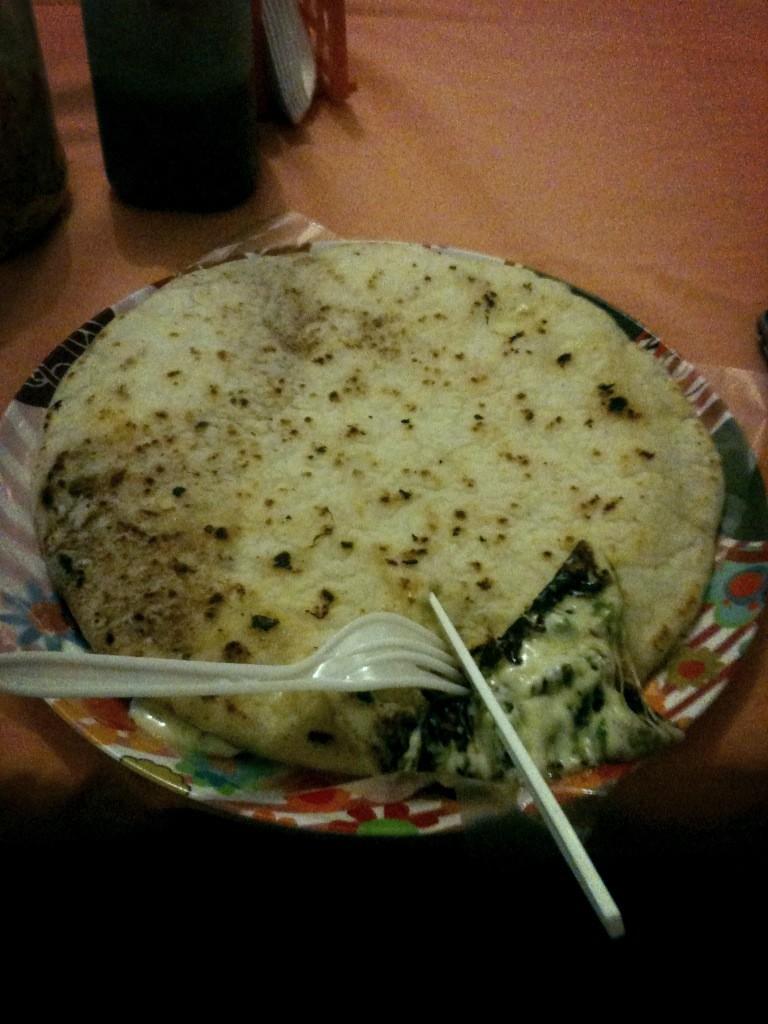
Nor should you ever bee seen eating a pupusa like this, because fuck tools right?


Instead, you must punish your fingers by ripping this grease-covered, hell-pocket apart as quickly as you can, like so:


Despite all this pain and regret, I rarely miss my nightly appointment with my pupusas. Chicharron, revuelta con loroco, I can honestly say it's never hurt so good.

*(this is curtido)